|
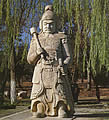
In the front part of imperial necropolises there is usually a "sacred way" or "divine road" for the spirits of the royal dead-- in which the ancients believed to walk on. This road is often lined with stone statues of men and animals as important decorations of the grounds.
The traditional name for the giant-sized statues of men, popularly called "stone men", is strictly wengzhong. It is said that a herculean giant by the name of Ruan Wengzhong lived in the Qin Dynasty (221-207 B. C.) and distinguished himself with great service in garrisoning the borders in Gansu and in fighting the Huns. After he died, Emperor Qin Shi Huang, to commemorate him, had a bronze statue carved in his likeness and erected at his palace in Xianyang. It is also said that, when Huns came to Xianyang and saw the statue, they thought Wengzhong was still alive. After that, all bronze men (and then stone statues) standing guard at palaces and imperial tombs came to be known as Wengzhong.
As for the stone animals, they have their origin in the following historical event:
Huo Qubing (140-117 B. C.) was a young military genius in the period of the Western Han. Distinguished in archery and horsemanship, he became an imperial attendant at age 17 and was several times sent on expeditions under his uncle Wei Qing, a famous commander, to fight the marauding Huns. He was given a command himself at 19 and twice led government forces to what was present-day Gansu and dealt telling blows to the Huns. He died at the age of 23 only. Emperor Wudi built for his beloved young general a magnificent tomb at Maoling and, to perpetuate the fame of his exploits in the northwest, had the mausoleum grounds landscaped like the Qilian Mountains where the battles had been fought. And as the mountain range is marked by rugged rocks that resemble wild beasts, so Huo's tumulus was strewn with grotesque rocks; furthermore, masons building the tomb sculptured many stone statues of animals-- leaping and squatting horses, resting tigers, kneeling elephants, piglets and fish, bears and other wild beasts preying on sheep... Of the sculptures, the most renowned is one showing a Hun under the hoof of a galloping horse, a work of art aptly summing up the achievements of the young general in his meteoric career.
The group of statues are the earliest giant-sized stone sculptures known to stand in front of an ancient tomb in China.
Emperors in later epochs, taking their cue from this, had stone men and animals made for their own tombs, and they are now a common sight to greet visitors to imperial mausoleums of the Tang, Song, Ming and Qing dynasties.
The group of giant stone figures that stand on the grounds of the Ming Tombs near beijing are the best preserved, the most true-to-life and most skilfully carved of their kind.
Erected where they are in A. D. 1435 (or the 10th year of the reign of the Ming Emperor Xuande), they consist of 12 human figures (civil and military officials and courtiers with meritorious records) and 24 animals (lions, camels, xiezhi, elephants, qilin, and horses-four of each, two standing and two squatting). The human figures were meant to imply firm and popular support to the imperial house, while the animals in different postures signified alternate day and night services to the dead monarchs.
Besides, different animals had each their symbolic significance:
The lion, ferocious in nature and lording it over the animal kingdom, symbolized awesome solemnity.
The camel and elephant, being dependable means of transport in the deserts and tropics, put together at the imperial tombs, were meant to suggest the vastness of the territory controlled by the court.
The xiezhi, a mythological unicorn which was supposed to possess a sixth sense to tell between right and wrong and which, when two men were embroiled in a fight, would gore the wicked one, was put there to keep evil spirits away.
 Tours to Sacred Way Tours to Sacred Way
|
|