|
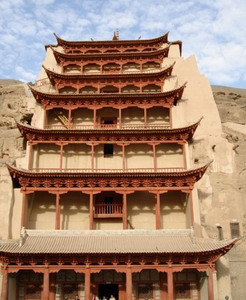
Located in Gansu Province of China, Dunhuang is a renowned tourist city famous for the Mogao Grottoes. On this land, you will discover vast expanse of sky and Gobi desert, where the relics of ancient castles, the preserved section of Silk Road, the Han dynasty Great Wall, and merry songs on the grassland merge into one another.
Dunhuang has 492 grottoes, with 45,000 square meters of frescos, 2, 415 painted statues and five wooden-structured grottoes. The Mogao Grottoes contain priceless paintings, sculptures, some 50,000 Buddhist scriptures, historical documents, textiles, and other relics that first stunned the world in the early 1900s.
Over a period of approximately 1,000 years, beginning in AD 366, the stone caves were excavated in the area of Dunhuang, eventually forming a 1,680-metre-long south-north complex.
Dunhuang art reached its zenith during the Sui (581-618) and Tang (618-907) dynasties. It adopted Chinese delineation and Western patch coloring, creating depictions of human expressions that were remarkably life-like and elegant. Dancing images, such as those of flying deities, were especially brilliantly executed, captivating all who have seen them.
History of Dunhuang
Dunhuang was made a prefecture in 117 BC by Emperor Han Wudi, and was a major point of interchange between ancient China and Central Asia during the Han and Tang dynasties. Located in western end of Hexi Corridor near the historic junction of the Northern and Southern Silk Roads, it was a town of military importance.
Early Buddhist monks accessed Dunhuang via the ancient Northern Silk Road, the northernmost route of about 2,600 kilometres (1,600 mi) in length, which connected the ancient Chinese capital of Xi'an to the west over the Wushao Ling Pass to Wuwei and emerging in Kashgar.For centuries Buddhist monks at Dunhuang collected scriptures from the west, and many pilgrims passed through the area, painting murals inside the Mogao Caves or "Caves of a Thousand Buddhas."A small number of Christian artifacts have also been found in the caves (see Jesus Sutras), testimony to the wide variety of people who made their way along the silk road.
Today, the site is an important tourist attraction and the subject of an ongoing archaeological project. A large number of manuscripts and artifacts retrieved at Dunhuang have been digitized and made publicly available via the International Dunhuang Project.
 China tours inclusive of visiting Dunhuang China tours inclusive of visiting Dunhuang
|
|