|
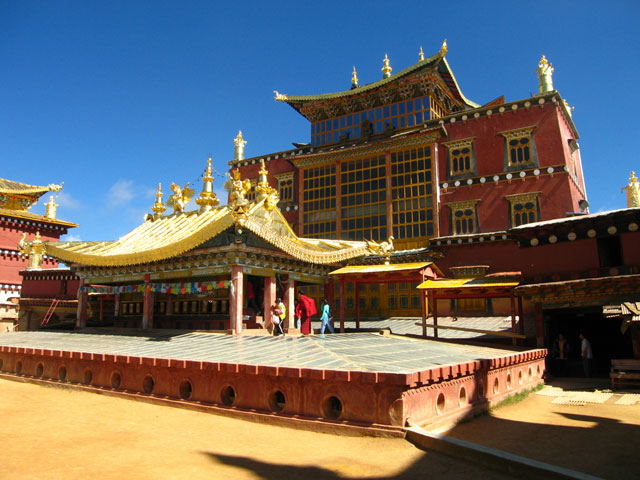
Gadain Sumzanling Monastery is a must for tourists. On the way to the monastery are hills, where, at harvest time, the highland barley known as qingke waits to be harvested by Tibetan women working the fields. This scene is reminiscent of French artist Jean Francois Millet's painting "Gleaners."
Sumzanling is the largest Tibetan Buddhism monastery in Yunnan Province. Covering an area of 30 hectares, it looks like a mini Kumbum (Ta'er) Monastery. It is located on a mountain slope five kilometers from the county town of Shangri-la. At sunset, the lamasery is shrouded in a mysterious atmosphere - thangka paintings line the corridors and the lamas chant sutras. Such a sacred place seems to purify the soul.
Since the 5th Dalai Lama chose the site through divination in 1679, the monastery has grown into the most important community of its kind in Yunnan. Naturally, throughout its history spanning 325 years there have been ups and downs – the Cultural Revolution (1966-1976), for instance, saw the lamasery almost completely destroyed – but the strong faith of the people of Shangri-La has always prevailed, and today Sumzanling once again houses more than 700 monks and lamas.
Built in the style of Potala Palace in Lhasa, Tibet, the magnificent monastery complex resides on top of a hill and consists of the two Zhacang and Jikang lamaseries – which take on the form of five-story Tibetan watchtowers – five gates, numerous sub-lamaseries and hundreds of rooms for the monks. Walking up the 146 steps that lead to the main prayer hall is a tiring exercise at 3,300 meters above sea level, but it allows you to trace mentally the pilgrimage route that generations of devout Buddhists living on the plateau take on their knees and foreheads every year.
On the way, you’ll come across study rooms where young monks who typically enter the monk hood at the age of 5 are trained in the scriptures and foundations of monastic life. The range of subjects that these boys have to cover is wide, from Tibetan language, grammar and literature to sutra chanting and prayers. Time will be spent on the Buddhist canons, yet crafts, astrology and medicine are also on the curriculum. In addition, the boys retreat for hours each day to reflect and meditate on the meaning and implications of Buddhist philosophy. Having a conversation with a young lama is indeed an interesting experience, if you are fortunate enough to speak Mandarin or Tibetan.
The main scripture hall in the center of the compound is the highlight of any visit, especially during prayer time in the morning or during auspicious festivals when devotees come from all over the province to take part in the festivities. The hall itself can accommodate some 1,600 lamas sitting in meditation or chanting Buddhist scriptures and features 108 imposing pillars. As Sumzanling is affiliated with the Gelugpa or Yellow Hat sect of Tibetan Buddhism, which is the order of both the Dalai Lama and Panchen Lama, references to the sect’s history and philosophy are found throughout the lamasery.
Amongst the monastery’s many treasures are rare Buddhist scriptures written on palm leaves, which have been used by previous Dalai and Panchen Lamas, as well as the eight famous gold-covered sculptures of Sakyamuni, the Indian prince who in the 5th century BC founded Buddhism and is popularly known as the “Sage of the Shakya Clan”. Colorful murals painted by renowned lamas show guardian deities, scenes from the Lord Buddha’s life, and the “wheel of life” that (held by the demon of impermanence) depicts the six realms of existence: heaven, demigods, humankind, hell, hungry ghosts and animals. The hub in the wheel’s center symbolizes ignorance, hatred and greed, the three poisons of life.
 China tours inclusive of visiting Songzanlin Monastery, Zhongdian China tours inclusive of visiting Songzanlin Monastery, Zhongdian
|
|